A few years ago I fixed a Washington Post candidate quiz using a spreadsheet. The problem with WaPo's version was that you could express your position on various issues but not how much you cared, which skewed the results.
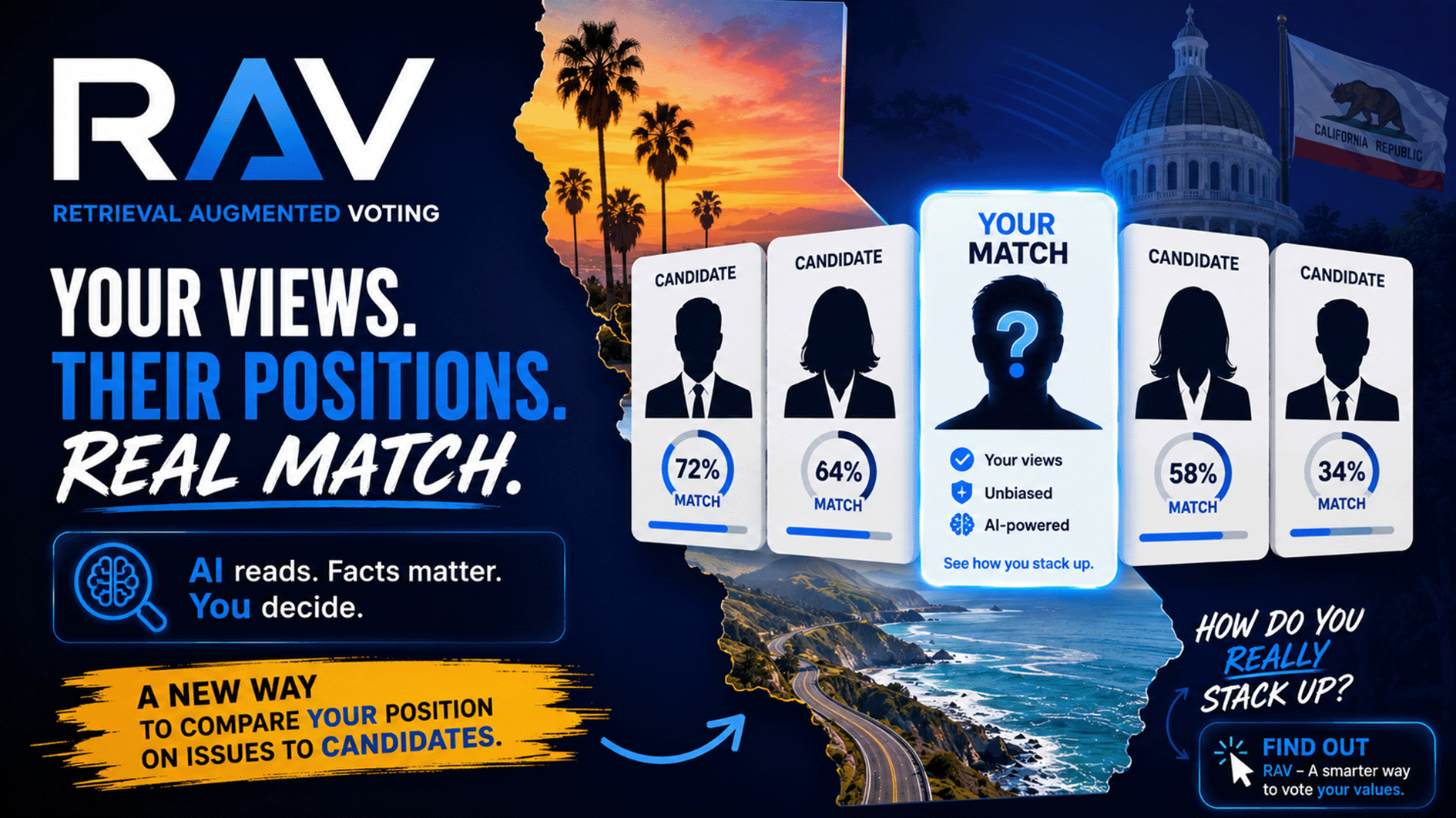
I just launched a site to help with the large field of candidates for California Governor in the June primary.
This is much better than the spreadsheet. Instead of binary positions you answer ten questions with a sentence or two outlining your position on each issue. It doesn't need to be an essay, this works well with pretty directional statements. For each issue you also indicate how much you care on a 1-5 scale.
The site calculates the match between you and each candidate, weighted based on issue importance and then returns a ranked list as well as a summary of the candidates positions on each issue. Positions are included for Xavier Becerra, Chad Bianco, Steve Hilton, Matt Mahan, Katie Porter, Tom Steyer, Tony Thurmond and Antonio Villaraigosa.
Unfortunately it can't help with the tactics of voting in a jungle primary. I really wish ranked choice voting was a feature of this election so I could vote my preference without fear of allowing one of my least favorite candidates to reach the general election.
Technically this site is an experiment in using a lot of AI.
I researched candidate positions using OpenAI deep research to arrive at a brief paragraph for each candidate and issue.
The UX is courtesy of Claude Design which created a design system based on this blog but punched up the look and feel for a new microsite.
The site itself was created with Codex and GPT 5.5 and lives in a Cloudflare worker.
Candidate ranking is based on vectors - candidate and user positions are converted to embeddings using OpenAI text-embedding-3-large and then cosine similarity and simple weighting of issue importance generates the final score for each prospective Governor.
All of that probably took the same amount of time as the spreadsheet version from 2020.
Public approval of Congress hovers in the teens, but instead of kicking them out, we reelected incumbents 97 percent of the time in 2024. Representatives fear primary challenges more than voters, and they spend much of their time fundraising for the next election.
We could get rid of gerrymandering, impose term limits, extend House terms, and introduce federal funding for elections.
Instead, we have Proposition 50. This introduces a completely partisan redistricting of California with the intent of counteracting a similar effort in Texas. It expires with the normal redistricting that will follow the 2030 census, although who knows if that will actually happen. It will likely spark repetition in more states.
With much regret, I'm a yes on 50.
It will be impossible to fix America's creaky democracy once it no longer exists.
I'm not in favor of quietly returning to the status quo in 2030. We have learned how much of our system depends on good intent, and this must change. Demand a citizen-driven constitutional convention. Resist the failed state that we seem intent on becoming.
As with my San Francisco voter guide I created a custom GPT with the California ballot measures and my voting history, to try and automate figuring out how I would vote this year. San Francisco went really well and required just some light editing. For some unknown reason the California version really struggled. I'm using the same approach of having the GPT summarize the proposition, summarize my previous voting record on related issues and then make a recommendation. I had to do a lot of fine tuning of the second prompt to get it to come up with anything sensible. The custom GPT is here, and the recommendations are below:
2: Authorizes Bonds for Public School and Community College Facilities. Legislative Statute.
Proposition 2 authorizes $10 billion in bonds to repair, upgrade, and build new facilities at K-12 public schools and community colleges. This funding is essential to address urgent health and safety issues, such as fixing deteriorating infrastructure, modernizing classrooms, and ensuring students have access to 21st-century learning environments. The proposition also includes strong accountability measures, such as public audits, ensuring that funds are spent as promised. Given my consistent support for school bond measures in the past to improve public education and infrastructure, Proposition 2 deserves a YES vote to invest in the future of California’s students.
3: Constitutional Right to Marriage. Legislative Constitutional Amendment.
Proposition 3 updates California’s Constitution to formally recognize the right to marry regardless of gender or race, removing outdated and discriminatory language that limits marriage to being between a man and a woman. This measure reflects existing federal law and aligns with California’s legacy of protecting civil rights and personal freedoms. As I have consistently supported marriage equality, a YES vote ensures we safeguard these rights for future generations while removing the remnants of discriminatory language from our state Constitution. Vote YES on Proposition 3 to continue advancing equality.
4: Authorizes Bonds for Safe Drinking Water, Wildfire Prevention, and Protecting Communities and Natural Lands from Climate Risks. Legislative Statute.
This measure authorizes $10 billion in bonds to fund safe drinking water projects, wildfire prevention, and the protection of communities and natural lands from climate change. With California facing increasing threats from droughts, wildfires, and other climate-related disasters, this is a necessary investment in our future. While I usually approach new debt cautiously, this proposition addresses urgent needs that we cannot afford to ignore. Protecting our water supply, reducing fire risks, and enhancing climate resilience are critical actions we must take now to safeguard future generations. Vote YES on Proposition 4.
5: Allows Local Bonds for Affordable Housing and Public Infrastructure with 55% Voter Approval. Legislative Constitutional Amendment.
Proposition 5 would allow local governments to pass bonds for affordable housing and public infrastructure with a 55% voter threshold instead of the current two-thirds requirement. While addressing the housing crisis is important, this measure would shift more financial burdens onto local taxpayers by making it easier to raise property taxes through bond financing. With local governments already struggling to manage debt and rising costs, lowering the voter approval threshold could lead to more irresponsible spending and higher taxes without clear benefits. I recommend voting NO on Proposition 5 to prevent unnecessary increases in local debt and tax burdens.
Yes: Proposition 6 seeks to eliminate the constitutional provision that allows involuntary servitude, or forced labor, as punishment for incarcerated persons in California. This measure would align the state's constitution with modern human rights standards, prioritizing rehabilitation over punitive practices. In the past, I've consistently supported reforms that emphasize rehabilitation over harsh penalties, particularly when they improve long-term outcomes for individuals and society. A "YES" vote on Proposition 6 continues this trend, ensuring California moves away from outdated practices and toward more humane treatment of incarcerated individuals.
32: Raises Minimum Wage. Initiative Statute.
Proposition 32: Vote Yes - Proposition 32 will raise the minimum wage to $18 per hour by 2026, addressing the growing cost of living and ensuring that service and essential workers, who have been hit hardest by inflation, can afford basic necessities. California’s wage increases have lagged behind rising corporate profits, leaving too many working people behind. While opponents argue that it will hurt businesses, the reality is that working families need a living wage to survive in this state. As with previous measures supporting economic equality and protections for lower-income communities, this is a step toward ensuring fairness in the workforce. Vote Yes on 32 to help working Californians keep up with the cost of living.
33: Expands Local Governments’ Authority to Enact Rent Control on Residential Property. Initiative Statute.
Proposition 33 seeks to repeal the Costa-Hawkins Rental Housing Act, allowing local governments to expand rent control across more types of residential properties, including newer buildings and single-family homes. While the stated goal is to provide relief to renters, this measure would likely lead to reduced housing development, decreased property values, and a worsening of the state's housing crisis. Based on past voting preferences that emphasize protecting property rights and avoiding policies that discourage investment, I recommend voting NO on Proposition 33. This measure will do more harm than good by stifling the creation of much-needed new housing.
34: Restricts Spending of Prescription Drug Revenues by Certain Health Care Providers. Initiative Statute.
Proposition 34 mandates that healthcare providers must spend 98% of revenues from the federal 340B drug discount program on direct patient care, introducing severe penalties for non-compliance. While well-intentioned, this measure places an unreasonably rigid requirement on how organizations allocate their resources. It’s crucial to trust healthcare organizations to manage their finances based on their unique operational needs, with performance and outcomes guiding support. Vote No on Proposition 34, as it imposes unnecessary restrictions and could harm the ability of providers to operate effectively.
35: Provides Permanent Funding for Medi-Cal Health Care Services. Initiative Statute.
Proposition 35 seeks to secure permanent funding for Medi-Cal by continuing an existing tax on managed healthcare plans. This measure is crucial for maintaining healthcare services to low-income Californians without imposing new taxes. Based on my past votes, I consistently support measures that ensure essential services like healthcare remain available to the most vulnerable populations, especially when there is no new tax burden on the general public. Vote YES on Proposition 35 to protect access to vital healthcare for millions of Californians.
36: Allows Felony Charges and Increases Sentences for Certain Drug and Theft Crimes. Initiative Statute.
Yes: Proposition 36 closes the dangerous loophole that allows repeat offenders to escape serious consequences for committing petty theft under $950. By reclassifying these crimes as felonies for individuals with two or more prior convictions, it ensures that those who repeatedly steal or traffic dangerous drugs like fentanyl face appropriate punishment. This measure restores accountability and enhances public safety by targeting serial offenders, who have been taking advantage of lax enforcement. A “Yes” vote on Proposition 36 is a vote for tougher penalties on career criminals and a step towards safer communities.
Updated 2024-10-19 23:55:
To fully AI this post here's a NotebookLM generated podcast discussing the content.