Only four measures to decide on for June! I'm sure we'll be punished for this in November. Here goes:
Measure A, Earthquake Safety and Emergency Bond Measure
Measure A asks San Francisco for $535 million in general obligation bonds to seismically retrofit fire stations, harden police facilities, replace the 110-year-old Potrero Bus Yard, and finally extend the Emergency Firefighting Water System into the Sunset and Richmond, which apparently the previous three earthquake bonds since 2010 forgot about. The USGS puts the odds of a 6.7+ Bay Area earthquake in the next thirty years at 72%. Repayment runs about $933 million over 25 years and doesn't raise property tax rates above the existing cap.
Yes. Working fire infrastructure after an earthquake is a good use of funds. This also upgrades police stations and will be used for the Potrero Yard MUNI project. The MUNI part was previously defeated as a ballot measure in June 2022 (I voted for it then, and happy to do so again this year).
Measure B, Term Limits for Mayor and Board of Supervisors Charter Amendment
Measure B caps service as mayor or supervisor at two four-year terms over an entire human lifetime. Current law already limits supervisors to two consecutive terms with a four-year cooling-off period; this closes the loophole that lets a former officeholder return after sitting out. In the twenty-five years since district elections came back in 2000, exactly one person has used that loophole. Prop B amends the city charter to prevent it from happening again.
Yes. After two terms, find something else to do. More specifically this amendment means you can't take four years off and then run again, and I'm fine with this change.
Measure C, Gross Receipts Tax Exemption and Top Executive Pay Tax Increase Initiative
Measure C, sponsored by the SF Chamber of Commerce, accelerates a planned business tax cut by a year and raises the small-business gross-receipts exemption from $5 million to $7.5 million, helping about 800 businesses. The controller estimates it costs the city $30-40 million a year, in a year already $169 million in the hole. It also exists primarily to neutralize Prop D - if both pass, whichever gets more votes wins.
No. This is designed to kill measure D, which I also oppose, but it also costs $30-$40 million a year in more generous small business exemptions.
Measure D, Changes to Top Executive Pay Tax Initiative
Measure D, sponsored by SEIU and IFPTE Local 21, raises the Top Executive Pay Tax by 800-900% on companies with more than 1,000 employees and $1 billion in revenue whose top executive earns more than 100x the median worker, and redefines "median worker" from the median San Francisco employee to the median global one - which sweeps in basically every large retailer, bank, and tech firm with an SF office. Estimated revenue: $250-300 million a year. Several grocery chains and pharmacies have publicly threatened to leave if it passes.
No. This is a ridiculous tax and I want no part of it. I voted against this in 2020. If we want a tax to signal disapproval of large companies, perhaps it should be based on the percentage of stock that is locked up so you need to ring a bell to get it, but the employee with the key is on a break or otherwise busy. But I don't even think we should do that.
TLDR: If you live in San Francisco and have windows, please consider signing this letter.
I need to replace my front window. The wood is rotten. While San Francisco never gets that cold, all the cold there is whistles in through the gaps.
In general I want to make my house a little bit more energy efficient whenever I replace something. I'd assumed I could find some nice looking double paned replacements and get on with my life. Sane jurisdictions even require certain levels of insulation for this kind of project. San Francisco went the other way. There is a 14 page guide to the requirements. Which boil down to window originalism, if your house is old enough:
"Another significant difference is that vinyl, fiberglass, and aluminum windows often do not have an important detail that is common on most older wood windows: the Ogee (pronounced Oh-jee) lugs at the bottom of the top sash (also called the meeting rail) of a double-hung window."
Yes, when Meta and Red Hat cancelled their conferences in San Francisco I'm pretty sure it was the lack of Ogees.
What about some double paned units?
"There should be an interior space bar, preferably of a dark color, within the insulated unit that visually divides the interior and exterior grilles."
This relates to divided light windows (i.e. you've got multiple panes of glass in one window). You might want to just have a single double paned window, but no, it needs to be in keeping with the original. You might then think that you could put some wood details over that single window but no, just in case someone looks closely and at an angle there has to be a shim inside to simulate it being multiple individual panes.
Doesn't the city care about the environment at all?
"While the advantages of double-paned windows are well known, a properly weatherstripped, single-glazed sash window can greatly reduce or eliminate air, noise and air infiltration (where most energy is lost)."
Greatly reduced is doing a lot of heavy lifting here. Looking at U Values here, the rate of energy transfer in watts per square meter per Kelvin (1°C = 1K) – W/m2K, old single pane windows are over 4.8, modern double paned are 1.3 and triple paned 0.8. Lower is better, almost four times better just for double paned.
I don't know exactly how these requirements came into force. It could be out of touch planners wanting windows for a more civilized era. Maybe there is a concentrated benefit / diffuse cost thing going on in favor of a few eye wateringly expensive custom window builders. But when you're trying to pretend that single paned windows are a boon to the environment something has clearly gone very wrong.
Even at the aesthetic level I'm not sure we need all the Ogees. I love the chaotic architectural chaos of San Francisco. The hot pink victorian next to the grey brutalist remodel. It's part of the charm of the city. Also, the expense of complying with what was popular 100 years ago cannot help with affordability, a key challenge.
Happily my supervisor, Myrna Melgar, has proposed legislation to shred this document and allow most people to choose replacement windows that best fit their needs. It looks like her proposal is currently on a three month vacation with the planning department. If you have windows and live in San Francisco you should probably care about this, and you can sign a letter to show your support for the change here.
As ever a brutal slate of propositions to decide on for the election. I've been blogging my choices since 2012 so I have a decent archive at this point and decided to automate. I built a custom GPT from the 300 page voter guide and my previous ballot measure related posts. I then interviewed the GPT on each proposition, asking for a summary, related issues that I have voted on previously and then a concise recommendation based on my voting history. I've made some light edits and it can be a bit salesy at times, but I think it's captured the right angle on everything. If you want more detail you can chat with it here.
A: Schools Improvement and Safety Bond
Proposition A is a $790 million bond measure for the San Francisco Unified School District, aimed at making critical upgrades to aging infrastructure, including seismic retrofitting, classroom modernization, and technology improvements. While concerns about past financial mismanagement in the district are valid, the need for safe, functional school facilities is undeniable. A strong education system requires investment, and Proposition A offers a targeted, practical way to address overdue infrastructure needs without raising taxes. Vote Yes on Proposition A to ensure our schools are safe, modern, and capable of meeting students' needs.
B: Community Health and Medical Facilities, Street Safety, Public Spaces, and Shelter to Reduce Homelessness Bond
Proposition B - Yes. This $390 million bond measure will fund necessary upgrades to health facilities like Zuckerberg SF General and Laguna Honda, improve street safety, and create housing for homeless families. It’s a no-brainer to support critical infrastructure improvements that will protect public health and ensure our medical centers are earthquake-safe. The homelessness crisis also demands urgent attention, and this bond promises over 2,300 new units without raising taxes. Past measures focusing on safety, health, and homelessness have garnered my support, and with strong oversight and no new taxes, this is an easy "Yes."
C: Inspector General
Proposition C would create an independent Inspector General within the Controller’s Office to investigate fraud, waste, and abuse in city government. This measure gives the Inspector General the necessary powers, including the ability to subpoena records, to effectively hold city officials and contractors accountable. Given the numerous scandals in recent years, establishing a robust oversight mechanism is crucial for restoring trust in our government. In the past, I've consistently supported reforms that promote transparency and accountability, and this measure is no exception. Vote YES to combat corruption and strengthen oversight in San Francisco.
D: City Commissions and Mayoral Authority
Proposition D seeks to reduce the number of city commissions and grant the Mayor greater authority to appoint and remove department heads without Board of Supervisors' confirmation. While the measure promises efficiency and cost savings, it concentrates too much power in the Mayor's office, diminishing vital checks and balances. The proposed elimination of commissions also weakens public oversight and community involvement in city governance. In the past, I’ve consistently voted to safeguard accountability and ensure broader public participation in government decisions. For these reasons, I recommend voting NO on Proposition D.
E: Creating a Task Force to Recommend Changing, Eliminating, or Combining City Commissions
Proposition E establishes a Commission Streamlining Task Force to review San Francisco’s numerous commissions and recommend changes, including consolidations and eliminations, to improve efficiency. While we must safeguard public oversight, the measure carefully balances reform with maintaining critical functions by allowing the Board of Supervisors to block any overreach. Given the bloated state of city commissions and the need for responsible governance, this is a measured step towards improving accountability and cutting redundancy. Vote Yes on Proposition E for smarter, more efficient government.
F: Police Staffing and Deferred Retirement
This measure would reintroduce a Deferred Retirement Option Program (DROP) to allow senior police officers to defer retirement while earning pension benefits, with the aim of addressing San Francisco's police staffing shortages. However, the program echoes the failed 2008-2011 DROP, which was discontinued due to high costs and minimal impact on staffing levels. The projected $600,000 to $3 million annual cost burden for the city, combined with the likelihood of "double-dipping" by officers, makes this a fiscally irresponsible solution. I recommend voting No on Proposition F, as it represents another costly and ineffective attempt to fix a complex issue.
G: Funding Rental Subsidies for Affordable Housing Developments Serving Low Income Seniors, Families, and Persons with Disabilities
Proposition G establishes the Affordable Housing Opportunity Fund to provide rental subsidies for extremely low-income seniors, families, and persons with disabilities, funded by at least $8.25 million annually from the City starting in 2026. The measure aims to bridge the gap between affordable housing costs and what these vulnerable groups can afford. I recommend voting Yes on Proposition G. It offers a targeted solution to address San Francisco’s housing crisis for the most vulnerable, aligns with past support for social safety net measures, and ensures long-term investment in affordable housing without jeopardizing the City’s budget stability.
H: Retirement Benefits for Firefighters
This measure seeks to lower the retirement age for firefighters hired after 2012 from 58 to 55, aligning their benefits with those hired before that date. While fairness across hire dates is important, we must remember why the 2011 pension reforms were implemented: to ensure the long-term financial stability of the city's pension system. Undoing those reforms now, at a cost of millions, risks repeating the mistakes of the past, particularly as San Francisco still faces significant fiscal challenges. Firefighters already receive some of the highest compensation in the Bay Area, and rolling back these necessary reforms would be irresponsible. Vote NO to protect San Francisco's financial future.
I: Retirement Benefits for Nurses and 911 Operators
Proposition I seeks to extend retirement benefits to Registered Nurses and 911 dispatchers by allowing nurses to purchase additional service credits and moving dispatchers to a more generous pension plan. While the city is facing staffing shortages in these vital roles, the measure increases pension liabilities by $3.8 to $6.7 million annually at a time when San Francisco already has a $790 million budget deficit. Similar to past pension-related propositions, I oppose expanding benefits that deepen our financial obligations without addressing the structural issues that contribute to these shortages. San Francisco needs fiscal responsibility and long-term solutions, not quick fixes that will only worsen the city's budget woes. Vote No on I.
J: Funding Programs Serving Children, Youth, and Families
Proposition J creates the "Our Children, Our Families" initiative to improve oversight of City funds supporting children, youth, and family services. It increases accountability by requiring annual reports and a comprehensive five-year spending plan for key funds like the Public Education Enrichment Fund (PEEF). Given my strong support for past measures that prioritize stable, dedicated funding for children and family programs, this proposition is a natural continuation of ensuring our city’s resources are used effectively for the next generation. Vote YES to strengthen oversight and maximize the impact of these crucial services.
K: Permanently Closing the Upper Great Highway to Private Vehicles to Establish a Public Open Recreation Space
Yes. This measure will permanently close the Upper Great Highway to private vehicles, converting it into public recreational space. Exceptions will be made for emergency and official vehicles, creating a safe, car-free area for walking, biking, and other activities. In the past, I’ve supported keeping spaces like JFK Drive in Golden Gate Park closed to cars, and this is no different. Let’s protect our coastline, reduce traffic, and keep this beautiful area open for everyone to enjoy without the disruption of cars.
L: Additional Business Tax on Transportation Network Companies and Autonomous Vehicle Businesses to Fund Public Transportation
Yes. Proposition L proposes a business tax on transportation network companies (TNCs) like Uber and Lyft, as well as autonomous vehicle businesses, to fund Muni's services. The tax would ensure these companies contribute to maintaining San Francisco's public transit system, which is critical for reducing traffic congestion and emissions, while protecting Muni services from cuts. Given the City's need for reliable public transportation, especially for vulnerable communities, this measure is a step towards making large businesses pay their fair share without passing the burden onto riders.
M: Changes to Business Taxes
Proposition M proposes changes to the business tax structure in San Francisco, increasing the small business exemption, simplifying tax categories, and adjusting rates on gross receipts, homelessness taxes, and administrative office taxes. While this measure aims to reduce tax burdens on smaller businesses, it also results in a significant short-term revenue loss—approximately $40 million annually until 2027. Given my consistent opposition to tax breaks that disproportionately benefit larger businesses while undermining essential public services (especially on previous homelessness and public health measures), this measure represents a dangerous gamble with city revenue. San Francisco cannot afford to lose crucial funds for services that need more support, not less. Vote NO on Proposition M.
N: First Responder Student Loan and Training Reimbursement Fund
This measure proposes the creation of a fund to reimburse first responders for student loan and training expenses, up to $25,000 per employee. While supporting first responders is vital, this measure introduces new financial obligations without a mandatory funding source, risking future taxpayer burdens. Similar to past pension-related measures, it offers a short-term fix for retention issues but fails to address systemic salary improvements or broader fiscal sustainability. For these reasons, I recommend a No vote on Proposition N.
O: Supporting Reproductive Rights
Proposition O affirms San Francisco’s role as a leader in protecting reproductive rights by expanding access to crucial reproductive health services, including abortion and emergency contraception. It establishes a city-maintained website listing providers and ensures transparency by requiring signage at facilities that do not offer these services. Additionally, it protects patient confidentiality from out-of-state inquiries and supports reproductive health funding. Given my consistent support for individual freedoms and opposition to government overreach in personal health matters, a Yes vote on Proposition O is a clear choice to safeguard reproductive rights in San Francisco.
Updated 2024-10-20 00:28:
This is a podcast version of the post created using NotebookLM.
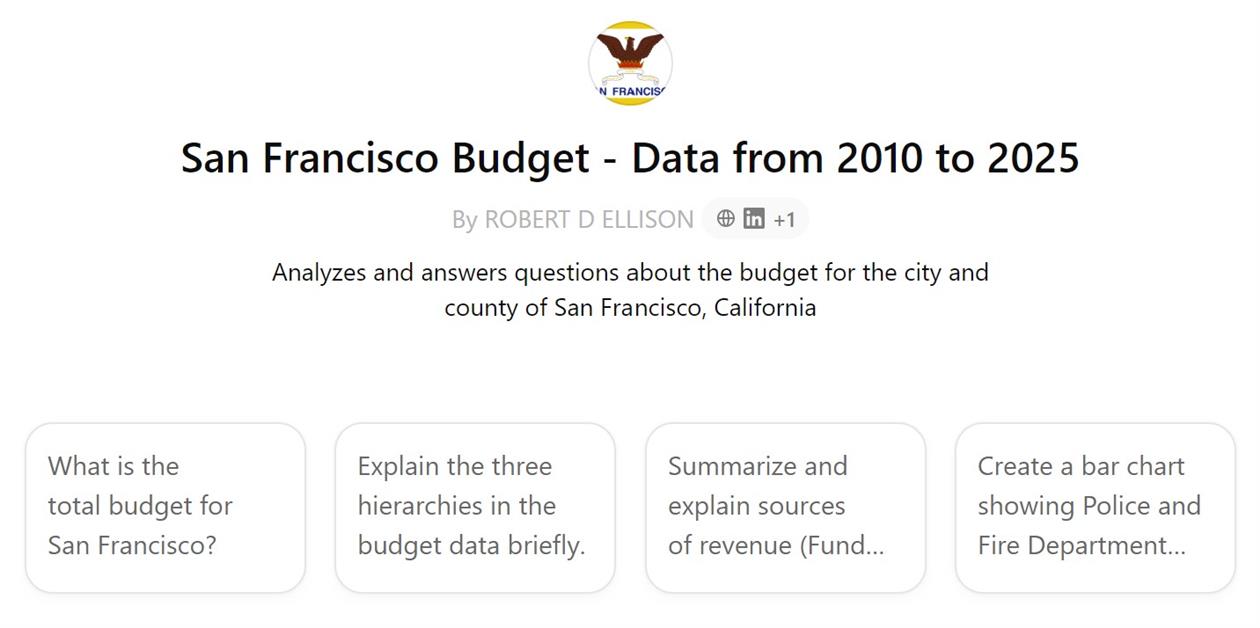
I just published a San Francisco Budget GPT to the ChatGPT store. This is free to use, you just need an OpenAI account.
The chatbot is constructed from the 2010-2025 data available on DataSF, the most recent 2025-2026 budget draft and a five year revenue projection. I added some instructions to help interpret the data and I've tested against a range of queries. This is generative AI and so be cautious about what it says. It's pretty good when it can find the right data and will happily invent things if it can't.
Not that this is limited to chatbots. There was a lot of press yesterday around San Francisco being the worst run city in the nation based on this 'analysis' from WalletHub. They are dividing a measure of service quality by budget dollars per capita. This fails to take into account that San Francisco is a city and a county and so the budget includes county services like a Sheriff department. It also ignores that San Francisco runs an international airport and port, not paid for by taxpayers but still in the budget. And it doesn't adjust for regional differences in income that make services more expensive to provide (and higher total dollar taxes to provide them). So I'll take an occasional chatbot glitch over a willfully incurious press pushing out a PR piece that tickles their confirmation biases.