Only four measures to decide on for June! I'm sure we'll be punished for this in November. Here goes:
Measure A, Earthquake Safety and Emergency Bond Measure
Measure A asks San Francisco for $535 million in general obligation bonds to seismically retrofit fire stations, harden police facilities, replace the 110-year-old Potrero Bus Yard, and finally extend the Emergency Firefighting Water System into the Sunset and Richmond, which apparently the previous three earthquake bonds since 2010 forgot about. The USGS puts the odds of a 6.7+ Bay Area earthquake in the next thirty years at 72%. Repayment runs about $933 million over 25 years and doesn't raise property tax rates above the existing cap.
Yes. Working fire infrastructure after an earthquake is a good use of funds. This also upgrades police stations and will be used for the Potrero Yard MUNI project. The MUNI part was previously defeated as a ballot measure in June 2022 (I voted for it then, and happy to do so again this year).
Measure B, Term Limits for Mayor and Board of Supervisors Charter Amendment
Measure B caps service as mayor or supervisor at two four-year terms over an entire human lifetime. Current law already limits supervisors to two consecutive terms with a four-year cooling-off period; this closes the loophole that lets a former officeholder return after sitting out. In the twenty-five years since district elections came back in 2000, exactly one person has used that loophole. Prop B amends the city charter to prevent it from happening again.
Yes. After two terms, find something else to do. More specifically this amendment means you can't take four years off and then run again, and I'm fine with this change.
Measure C, Gross Receipts Tax Exemption and Top Executive Pay Tax Increase Initiative
Measure C, sponsored by the SF Chamber of Commerce, accelerates a planned business tax cut by a year and raises the small-business gross-receipts exemption from $5 million to $7.5 million, helping about 800 businesses. The controller estimates it costs the city $30-40 million a year, in a year already $169 million in the hole. It also exists primarily to neutralize Prop D - if both pass, whichever gets more votes wins.
No. This is designed to kill measure D, which I also oppose, but it also costs $30-$40 million a year in more generous small business exemptions.
Measure D, Changes to Top Executive Pay Tax Initiative
Measure D, sponsored by SEIU and IFPTE Local 21, raises the Top Executive Pay Tax by 800-900% on companies with more than 1,000 employees and $1 billion in revenue whose top executive earns more than 100x the median worker, and redefines "median worker" from the median San Francisco employee to the median global one - which sweeps in basically every large retailer, bank, and tech firm with an SF office. Estimated revenue: $250-300 million a year. Several grocery chains and pharmacies have publicly threatened to leave if it passes.
No. This is a ridiculous tax and I want no part of it. I voted against this in 2020. If we want a tax to signal disapproval of large companies, perhaps it should be based on the percentage of stock that is locked up so you need to ring a bell to get it, but the employee with the key is on a break or otherwise busy. But I don't even think we should do that.
I've sometimes wondered how often I agree with San Francisco on the endless ballot measures. I have a vague sense after each election but I've never bothered with the bigger picture. Thanks to AI it's now a pretty easy question to answer - I fed blog posts to ChatGPT and then the resulting data to Claude Opus to whip me up some python visualization. Which looks like this:
That's a decade of trying to understand what the measures actually mean and do the right thing.
Maybe there is a downward trend, but throw away the outliers and I'm pretty solidly around 70%. San Francisco should save the money and just ask me.
Public approval of Congress hovers in the teens, but instead of kicking them out, we reelected incumbents 97 percent of the time in 2024. Representatives fear primary challenges more than voters, and they spend much of their time fundraising for the next election.
We could get rid of gerrymandering, impose term limits, extend House terms, and introduce federal funding for elections.
Instead, we have Proposition 50. This introduces a completely partisan redistricting of California with the intent of counteracting a similar effort in Texas. It expires with the normal redistricting that will follow the 2030 census, although who knows if that will actually happen. It will likely spark repetition in more states.
With much regret, I'm a yes on 50.
It will be impossible to fix America's creaky democracy once it no longer exists.
I'm not in favor of quietly returning to the status quo in 2030. We have learned how much of our system depends on good intent, and this must change. Demand a citizen-driven constitutional convention. Resist the failed state that we seem intent on becoming.
I guess we have to pretend we want to shoot you in the face to win at this point?
Arizona, Michigan, and all the other swing states - I love you, but you should get one person one vote. We need a National Popular Vote. We need more ranked choice voting. But most of all we do not need another four years of Trump, and so I'll be enthusiastically voting Harris/Walz in 2024. I'd rather have whatever remains from this lettuce than suffer through another Trump term. If you have allowed yourself to believe that Harris is as much of a threat to democracy as Trump, remember that the supreme court is lost to the right for a generation, hold your nose, and vote Harris/Walz. If you're concerned that Walz has stretched the truth a couple of times in the service of a good story, check out these 30,573 examples from Trump.
Trump lost in 2020. Vance can't say it for some reason, and that's disqualifying just by itself. Trump lost the popular vote in 2016. 65% of Americans support electing the President on the popular vote (make it happen here). A majority of Americans support safe access to abortion. A majority of Americans favor stricter gun control laws. A majority of Americans support free college. A majority of Americans support Federal health care. A majority of Americans support same sex marriage (data here). This is a very sane country in thrall to a dangerous and dare I say deplorable minority. If you're not registered to vote, get registered. If you're Stein or Kennedy curious get that out of your system by writing your representative and demanding ranked choice voting. And then vote for Harris/Walz so we can put this Trump thing to bed and find some path back to a politics that actually works for America.
As with my San Francisco voter guide I created a custom GPT with the California ballot measures and my voting history, to try and automate figuring out how I would vote this year. San Francisco went really well and required just some light editing. For some unknown reason the California version really struggled. I'm using the same approach of having the GPT summarize the proposition, summarize my previous voting record on related issues and then make a recommendation. I had to do a lot of fine tuning of the second prompt to get it to come up with anything sensible. The custom GPT is here, and the recommendations are below:
2: Authorizes Bonds for Public School and Community College Facilities. Legislative Statute.
Proposition 2 authorizes $10 billion in bonds to repair, upgrade, and build new facilities at K-12 public schools and community colleges. This funding is essential to address urgent health and safety issues, such as fixing deteriorating infrastructure, modernizing classrooms, and ensuring students have access to 21st-century learning environments. The proposition also includes strong accountability measures, such as public audits, ensuring that funds are spent as promised. Given my consistent support for school bond measures in the past to improve public education and infrastructure, Proposition 2 deserves a YES vote to invest in the future of California’s students.
3: Constitutional Right to Marriage. Legislative Constitutional Amendment.
Proposition 3 updates California’s Constitution to formally recognize the right to marry regardless of gender or race, removing outdated and discriminatory language that limits marriage to being between a man and a woman. This measure reflects existing federal law and aligns with California’s legacy of protecting civil rights and personal freedoms. As I have consistently supported marriage equality, a YES vote ensures we safeguard these rights for future generations while removing the remnants of discriminatory language from our state Constitution. Vote YES on Proposition 3 to continue advancing equality.
4: Authorizes Bonds for Safe Drinking Water, Wildfire Prevention, and Protecting Communities and Natural Lands from Climate Risks. Legislative Statute.
This measure authorizes $10 billion in bonds to fund safe drinking water projects, wildfire prevention, and the protection of communities and natural lands from climate change. With California facing increasing threats from droughts, wildfires, and other climate-related disasters, this is a necessary investment in our future. While I usually approach new debt cautiously, this proposition addresses urgent needs that we cannot afford to ignore. Protecting our water supply, reducing fire risks, and enhancing climate resilience are critical actions we must take now to safeguard future generations. Vote YES on Proposition 4.
5: Allows Local Bonds for Affordable Housing and Public Infrastructure with 55% Voter Approval. Legislative Constitutional Amendment.
Proposition 5 would allow local governments to pass bonds for affordable housing and public infrastructure with a 55% voter threshold instead of the current two-thirds requirement. While addressing the housing crisis is important, this measure would shift more financial burdens onto local taxpayers by making it easier to raise property taxes through bond financing. With local governments already struggling to manage debt and rising costs, lowering the voter approval threshold could lead to more irresponsible spending and higher taxes without clear benefits. I recommend voting NO on Proposition 5 to prevent unnecessary increases in local debt and tax burdens.
Yes: Proposition 6 seeks to eliminate the constitutional provision that allows involuntary servitude, or forced labor, as punishment for incarcerated persons in California. This measure would align the state's constitution with modern human rights standards, prioritizing rehabilitation over punitive practices. In the past, I've consistently supported reforms that emphasize rehabilitation over harsh penalties, particularly when they improve long-term outcomes for individuals and society. A "YES" vote on Proposition 6 continues this trend, ensuring California moves away from outdated practices and toward more humane treatment of incarcerated individuals.
32: Raises Minimum Wage. Initiative Statute.
Proposition 32: Vote Yes - Proposition 32 will raise the minimum wage to $18 per hour by 2026, addressing the growing cost of living and ensuring that service and essential workers, who have been hit hardest by inflation, can afford basic necessities. California’s wage increases have lagged behind rising corporate profits, leaving too many working people behind. While opponents argue that it will hurt businesses, the reality is that working families need a living wage to survive in this state. As with previous measures supporting economic equality and protections for lower-income communities, this is a step toward ensuring fairness in the workforce. Vote Yes on 32 to help working Californians keep up with the cost of living.
33: Expands Local Governments’ Authority to Enact Rent Control on Residential Property. Initiative Statute.
Proposition 33 seeks to repeal the Costa-Hawkins Rental Housing Act, allowing local governments to expand rent control across more types of residential properties, including newer buildings and single-family homes. While the stated goal is to provide relief to renters, this measure would likely lead to reduced housing development, decreased property values, and a worsening of the state's housing crisis. Based on past voting preferences that emphasize protecting property rights and avoiding policies that discourage investment, I recommend voting NO on Proposition 33. This measure will do more harm than good by stifling the creation of much-needed new housing.
34: Restricts Spending of Prescription Drug Revenues by Certain Health Care Providers. Initiative Statute.
Proposition 34 mandates that healthcare providers must spend 98% of revenues from the federal 340B drug discount program on direct patient care, introducing severe penalties for non-compliance. While well-intentioned, this measure places an unreasonably rigid requirement on how organizations allocate their resources. It’s crucial to trust healthcare organizations to manage their finances based on their unique operational needs, with performance and outcomes guiding support. Vote No on Proposition 34, as it imposes unnecessary restrictions and could harm the ability of providers to operate effectively.
35: Provides Permanent Funding for Medi-Cal Health Care Services. Initiative Statute.
Proposition 35 seeks to secure permanent funding for Medi-Cal by continuing an existing tax on managed healthcare plans. This measure is crucial for maintaining healthcare services to low-income Californians without imposing new taxes. Based on my past votes, I consistently support measures that ensure essential services like healthcare remain available to the most vulnerable populations, especially when there is no new tax burden on the general public. Vote YES on Proposition 35 to protect access to vital healthcare for millions of Californians.
36: Allows Felony Charges and Increases Sentences for Certain Drug and Theft Crimes. Initiative Statute.
Yes: Proposition 36 closes the dangerous loophole that allows repeat offenders to escape serious consequences for committing petty theft under $950. By reclassifying these crimes as felonies for individuals with two or more prior convictions, it ensures that those who repeatedly steal or traffic dangerous drugs like fentanyl face appropriate punishment. This measure restores accountability and enhances public safety by targeting serial offenders, who have been taking advantage of lax enforcement. A “Yes” vote on Proposition 36 is a vote for tougher penalties on career criminals and a step towards safer communities.
Updated 2024-10-19 23:55:
To fully AI this post here's a NotebookLM generated podcast discussing the content.
As ever a brutal slate of propositions to decide on for the election. I've been blogging my choices since 2012 so I have a decent archive at this point and decided to automate. I built a custom GPT from the 300 page voter guide and my previous ballot measure related posts. I then interviewed the GPT on each proposition, asking for a summary, related issues that I have voted on previously and then a concise recommendation based on my voting history. I've made some light edits and it can be a bit salesy at times, but I think it's captured the right angle on everything. If you want more detail you can chat with it here.
A: Schools Improvement and Safety Bond
Proposition A is a $790 million bond measure for the San Francisco Unified School District, aimed at making critical upgrades to aging infrastructure, including seismic retrofitting, classroom modernization, and technology improvements. While concerns about past financial mismanagement in the district are valid, the need for safe, functional school facilities is undeniable. A strong education system requires investment, and Proposition A offers a targeted, practical way to address overdue infrastructure needs without raising taxes. Vote Yes on Proposition A to ensure our schools are safe, modern, and capable of meeting students' needs.
B: Community Health and Medical Facilities, Street Safety, Public Spaces, and Shelter to Reduce Homelessness Bond
Proposition B - Yes. This $390 million bond measure will fund necessary upgrades to health facilities like Zuckerberg SF General and Laguna Honda, improve street safety, and create housing for homeless families. It’s a no-brainer to support critical infrastructure improvements that will protect public health and ensure our medical centers are earthquake-safe. The homelessness crisis also demands urgent attention, and this bond promises over 2,300 new units without raising taxes. Past measures focusing on safety, health, and homelessness have garnered my support, and with strong oversight and no new taxes, this is an easy "Yes."
C: Inspector General
Proposition C would create an independent Inspector General within the Controller’s Office to investigate fraud, waste, and abuse in city government. This measure gives the Inspector General the necessary powers, including the ability to subpoena records, to effectively hold city officials and contractors accountable. Given the numerous scandals in recent years, establishing a robust oversight mechanism is crucial for restoring trust in our government. In the past, I've consistently supported reforms that promote transparency and accountability, and this measure is no exception. Vote YES to combat corruption and strengthen oversight in San Francisco.
D: City Commissions and Mayoral Authority
Proposition D seeks to reduce the number of city commissions and grant the Mayor greater authority to appoint and remove department heads without Board of Supervisors' confirmation. While the measure promises efficiency and cost savings, it concentrates too much power in the Mayor's office, diminishing vital checks and balances. The proposed elimination of commissions also weakens public oversight and community involvement in city governance. In the past, I’ve consistently voted to safeguard accountability and ensure broader public participation in government decisions. For these reasons, I recommend voting NO on Proposition D.
E: Creating a Task Force to Recommend Changing, Eliminating, or Combining City Commissions
Proposition E establishes a Commission Streamlining Task Force to review San Francisco’s numerous commissions and recommend changes, including consolidations and eliminations, to improve efficiency. While we must safeguard public oversight, the measure carefully balances reform with maintaining critical functions by allowing the Board of Supervisors to block any overreach. Given the bloated state of city commissions and the need for responsible governance, this is a measured step towards improving accountability and cutting redundancy. Vote Yes on Proposition E for smarter, more efficient government.
F: Police Staffing and Deferred Retirement
This measure would reintroduce a Deferred Retirement Option Program (DROP) to allow senior police officers to defer retirement while earning pension benefits, with the aim of addressing San Francisco's police staffing shortages. However, the program echoes the failed 2008-2011 DROP, which was discontinued due to high costs and minimal impact on staffing levels. The projected $600,000 to $3 million annual cost burden for the city, combined with the likelihood of "double-dipping" by officers, makes this a fiscally irresponsible solution. I recommend voting No on Proposition F, as it represents another costly and ineffective attempt to fix a complex issue.
G: Funding Rental Subsidies for Affordable Housing Developments Serving Low Income Seniors, Families, and Persons with Disabilities
Proposition G establishes the Affordable Housing Opportunity Fund to provide rental subsidies for extremely low-income seniors, families, and persons with disabilities, funded by at least $8.25 million annually from the City starting in 2026. The measure aims to bridge the gap between affordable housing costs and what these vulnerable groups can afford. I recommend voting Yes on Proposition G. It offers a targeted solution to address San Francisco’s housing crisis for the most vulnerable, aligns with past support for social safety net measures, and ensures long-term investment in affordable housing without jeopardizing the City’s budget stability.
H: Retirement Benefits for Firefighters
This measure seeks to lower the retirement age for firefighters hired after 2012 from 58 to 55, aligning their benefits with those hired before that date. While fairness across hire dates is important, we must remember why the 2011 pension reforms were implemented: to ensure the long-term financial stability of the city's pension system. Undoing those reforms now, at a cost of millions, risks repeating the mistakes of the past, particularly as San Francisco still faces significant fiscal challenges. Firefighters already receive some of the highest compensation in the Bay Area, and rolling back these necessary reforms would be irresponsible. Vote NO to protect San Francisco's financial future.
I: Retirement Benefits for Nurses and 911 Operators
Proposition I seeks to extend retirement benefits to Registered Nurses and 911 dispatchers by allowing nurses to purchase additional service credits and moving dispatchers to a more generous pension plan. While the city is facing staffing shortages in these vital roles, the measure increases pension liabilities by $3.8 to $6.7 million annually at a time when San Francisco already has a $790 million budget deficit. Similar to past pension-related propositions, I oppose expanding benefits that deepen our financial obligations without addressing the structural issues that contribute to these shortages. San Francisco needs fiscal responsibility and long-term solutions, not quick fixes that will only worsen the city's budget woes. Vote No on I.
J: Funding Programs Serving Children, Youth, and Families
Proposition J creates the "Our Children, Our Families" initiative to improve oversight of City funds supporting children, youth, and family services. It increases accountability by requiring annual reports and a comprehensive five-year spending plan for key funds like the Public Education Enrichment Fund (PEEF). Given my strong support for past measures that prioritize stable, dedicated funding for children and family programs, this proposition is a natural continuation of ensuring our city’s resources are used effectively for the next generation. Vote YES to strengthen oversight and maximize the impact of these crucial services.
K: Permanently Closing the Upper Great Highway to Private Vehicles to Establish a Public Open Recreation Space
Yes. This measure will permanently close the Upper Great Highway to private vehicles, converting it into public recreational space. Exceptions will be made for emergency and official vehicles, creating a safe, car-free area for walking, biking, and other activities. In the past, I’ve supported keeping spaces like JFK Drive in Golden Gate Park closed to cars, and this is no different. Let’s protect our coastline, reduce traffic, and keep this beautiful area open for everyone to enjoy without the disruption of cars.
L: Additional Business Tax on Transportation Network Companies and Autonomous Vehicle Businesses to Fund Public Transportation
Yes. Proposition L proposes a business tax on transportation network companies (TNCs) like Uber and Lyft, as well as autonomous vehicle businesses, to fund Muni's services. The tax would ensure these companies contribute to maintaining San Francisco's public transit system, which is critical for reducing traffic congestion and emissions, while protecting Muni services from cuts. Given the City's need for reliable public transportation, especially for vulnerable communities, this measure is a step towards making large businesses pay their fair share without passing the burden onto riders.
M: Changes to Business Taxes
Proposition M proposes changes to the business tax structure in San Francisco, increasing the small business exemption, simplifying tax categories, and adjusting rates on gross receipts, homelessness taxes, and administrative office taxes. While this measure aims to reduce tax burdens on smaller businesses, it also results in a significant short-term revenue loss—approximately $40 million annually until 2027. Given my consistent opposition to tax breaks that disproportionately benefit larger businesses while undermining essential public services (especially on previous homelessness and public health measures), this measure represents a dangerous gamble with city revenue. San Francisco cannot afford to lose crucial funds for services that need more support, not less. Vote NO on Proposition M.
N: First Responder Student Loan and Training Reimbursement Fund
This measure proposes the creation of a fund to reimburse first responders for student loan and training expenses, up to $25,000 per employee. While supporting first responders is vital, this measure introduces new financial obligations without a mandatory funding source, risking future taxpayer burdens. Similar to past pension-related measures, it offers a short-term fix for retention issues but fails to address systemic salary improvements or broader fiscal sustainability. For these reasons, I recommend a No vote on Proposition N.
O: Supporting Reproductive Rights
Proposition O affirms San Francisco’s role as a leader in protecting reproductive rights by expanding access to crucial reproductive health services, including abortion and emergency contraception. It establishes a city-maintained website listing providers and ensures transparency by requiring signage at facilities that do not offer these services. Additionally, it protects patient confidentiality from out-of-state inquiries and supports reproductive health funding. Given my consistent support for individual freedoms and opposition to government overreach in personal health matters, a Yes vote on Proposition O is a clear choice to safeguard reproductive rights in San Francisco.
Updated 2024-10-20 00:28:
This is a podcast version of the post created using NotebookLM.
I just sent this note to my senators (Padilla and Butler):
"Being a presidential voter in California is like playing the Trolley Problem without a lever. I know my vote won't make much of a difference, but I can no longer vote for President Biden. I was an enthusiastic supporter in 2020. I'm grateful that Biden defeated Trump. I'm proud of the work this administration has done to reduce carbon emissions, make healthcare more affordable and increase domestic semiconductor production.
While impressive, these accomplishments are sunk benefits. If Trump is allowed to prevail in the 2024 election much of this good work will be undone. That will likely be the least of our problems as a country. President Biden is now almost certain to lose the election. We are currently stuck with everyone realizing that this is true, but too few willing to make their position public. We risk a catastrophic election result unless a landslide of hard truths are delivered in the next few days.
Biden ran on a platform of being the bridge to a new generation of leadership. He must fulfil this promise and start the process of passing the torch immediately. As my representative please take a public position that this must happen as I'm sure you must privately believe. Thank you."
"In messages during the pandemic, he referred to ministers as “useless fuckpigs,” “morons,” and “cunts.” The inquiry’s lawyer asked Cummings if he thought his language had been too strong. “I would say, if anything, it understated the position,” he replied."
This is a depressing but definitive read as we wait for the UK election to be announced. #politics#uk
While waiting for the horror of Weekend at Bernie's vs. A Clockwork Orange in November there is time to contemplate another slate of job-outsourcing ballot measures. Just one for California and seven for San Francisco so it could be worse. Here goes...
California Proposition 1, Behavioral Health Services Program and Bond Measure
Yes. This funds housing and treatment for the mentally ill, homeless and veterans in need. It also requires counties to put more of their existing funds into housing.
San Francisco, California, Proposition A, Affordable Housing Bond Measure
Yes. $300M in bonds to build, buy and repair affordable housing. Homelessness is driven by a lack of affordable housing. In addition to building more I'd love to see us cut more of the red tape, but this is a necessary measure to meet our existing obligations.
San Francisco, California, Proposition B, Minimum Police Staffing Amendment
No. I voted against minimum numbers in 2020, and I don't see a good reason to bring them back today. I also recoil at the thought of a dedicated police recruitment tax as this measure suggests. Funding the police is a very basic city service, as is determining the appropriate staffing levels at any particular moment in time. I'm not against recruiting more police at all, but this is a bad proposal.
San Francisco, California, Proposition C, Real Estate Transfer Tax Exemption for Properties Converted from Commercial to Residential Use Initiative
Yes. I voted in favor of this tax in 2020. Post pandemic San Francisco has one of the worst return to office rates and a huge decline in retail. We need to rethink what downtown is for and I love the idea of bringing in more universities and more homes. So this is a tax break that makes sense for now.
San Francisco, California, Proposition D, Amend City Ethics Laws and Expand Restrictions on Gifts to City Officers and Employees Initiative
Yes. Tougher ethics rules are needed. Can't find any reason to oppose this package. We have bribing of inspection personnel, theft of public funds, corruption in Public Works, that inspector who inspected his own building, etc.
San Francisco, California, Proposition E, Limit Police Department Administrative Task Time and Increase Use of Camera and Drone Technology Initiative
Yes. Apparently when SFPD decides to chase someone they crash 38% of the time, about twice the state average. This bill would let them chase more people and use drones and GPS taggers to do it. I'd like them to go on an advanced driving course or two, but if you can avoid consequences just by running away then we don't really have a law enforcement system. Maybe I'll regret this in a few years but it seems mostly common sense to me right now.
San Francisco, California, Proposition F, Require Drug Screening for Certain Beneficiaries of the County Adult Assistance Program Initiative
No. It looks like the recipients of most of these funds are not homeless and have plenty of hoops to jump through already. This seems like it would risk making their situation worse.
San Francisco, California, Proposition G, Declaration of Policy Urging San Francisco Unified School District to Offer Algebra 1 to Students by Eighth Grade Measure
Yes. This is pointless as it has no teeth and they're moving this way anyway. I still want to help make the pointless point.
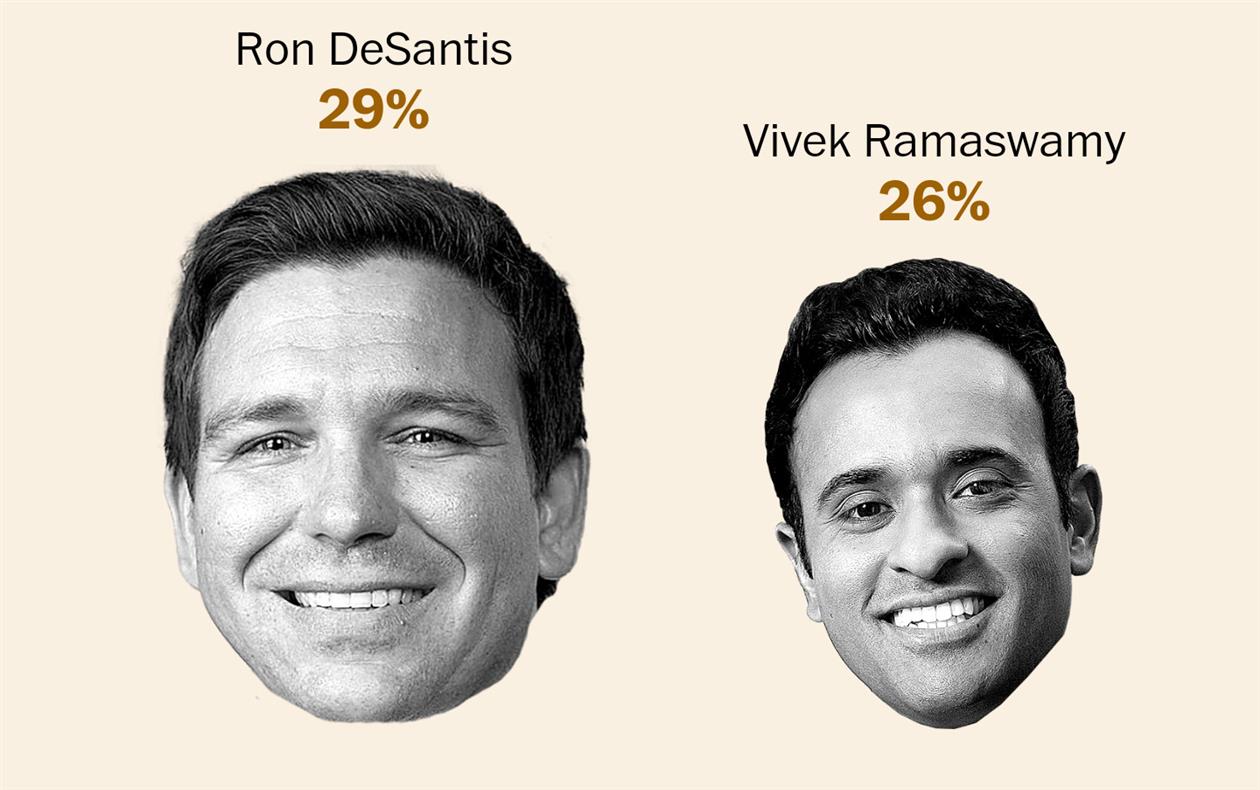
The photo above is how WaPo decided to illustrate their poll results after the first Republican debate. They say:
"Florida Gov. Ron DeSantis came out on top Wednesday night, with 29 percent of Republican voters who watched the debate saying he performed best."
And his head is much much bigger so it's clear who won. Except buried in the small print this is a three percentage point difference in a small poll with a +/- four percentage point margin of error. In other words, flat.
To be clear I want neither of these gentlemen installed in the White House. But this is pretty crappy data reporting.